Go2Appraiser Call 470.642.0232

Insurance and Property Damage Valuation

Two questions bring people here, and most people do not know an appraiser can answer either one. Is the house insured for the right amount? And did the damage cost the property value, even after the repairs were done?

Two questions, two different appraisals

An insurable value appraisal answers what it would cost to rebuild the house today. A diminution (dim-ih-NEW-shun) in value appraisal answers how much market value the property lost because of damage, even after a good repair.

Neither one is market value in the ordinary sense, and they are not interchangeable. They are built differently, they answer to different people, and they are ordered for different reasons. Knowing which one you need is most of the work of asking for it.

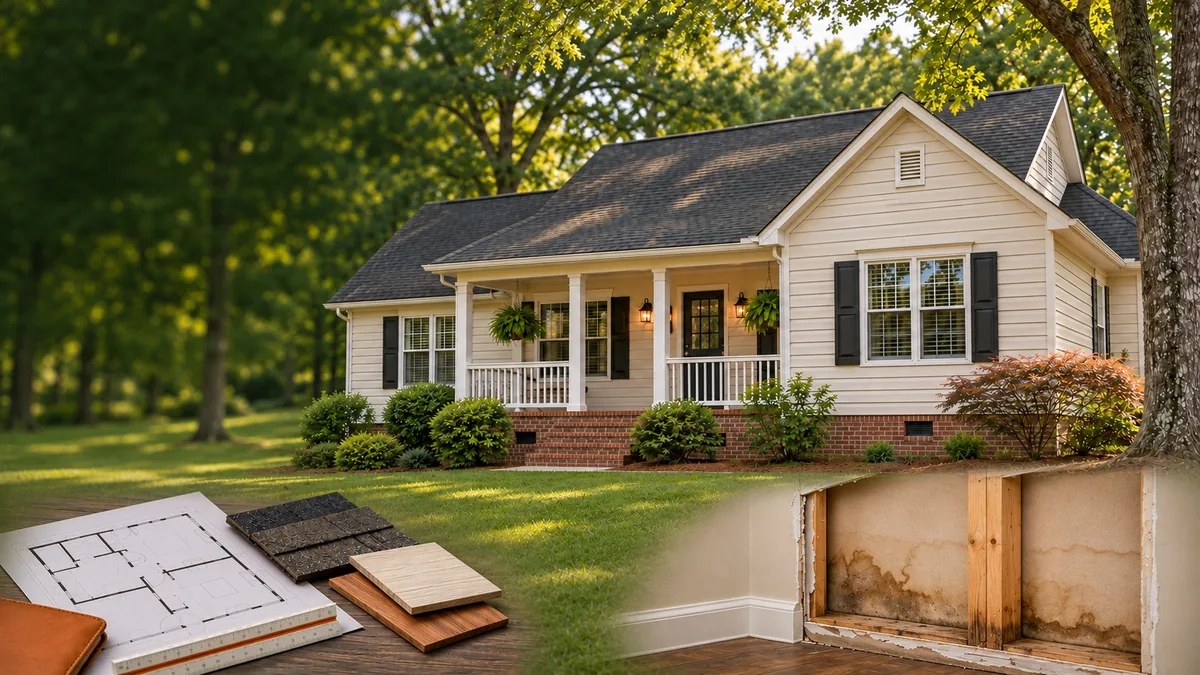
Illustration. A single storey house with a covered porch and brick foundation, with a floor plan, roof shingle samples and flooring samples laid out in front of it, and an inset at one corner showing an opened wall cavity with water staining on the studs.
Illustration. The same house, valued two different ways.

Is the house insured for the right amount?

This is a question about the building, not the land and not the sale price. A carrier's dwelling limit comes out of software fed a few inputs: square footage, a quality grade, the year built. It produces a total without showing the reasoning behind it.

An insurable value appraisal builds the figure component by component, from a published residential construction cost source adjusted to the county, so the number can be followed and any line of it questioned. Carried too high, the premium pays for coverage that is not needed. Carried too low, a total loss comes up short.

Did the damage cost the property value?

A repair can fix the house and still leave it worth less. Buyers discount a known history of fire, flood or mold, and that discount does not appear on the repair invoice.

A diminution in value appraisal measures it the only way it can honestly be measured: a value for the property without the loss, a value for it as repaired, and local sales showing what buyers actually paid for comparable homes with and without that history.

Why few appraisers take this work

It asks for three things in the same person. Construction cost knowledge detailed enough to price a rebuild line by line. Market analysis good enough to isolate what a known history does to a sale price. And enough experience under examination to put either conclusion in front of someone whose job is to take it apart.

Most residential practice never touches any of the three. I have worked every seat in this business since 1997 and have been licensed since 2000: field appraisal, Chief Review Appraiser at two national appraisal management companies, years on the other side of the desk reviewing other appraisers' work on disputed values, and litigation. I have performed, reviewed, consulted on and supervised insurable value and property damage assignments.

Who orders this work

Homeowners, most often. Someone who has just been through a fire, a flood or a remediation and wants to know what it did to the value of the house, or someone looking at a renewal who suspects the dwelling limit on the policy has drifted away from what rebuilding would actually cost.

Insurance agents and independent agencies order insurable value appraisals for clients who dispute a dwelling limit, or who want a documented basis before shopping carriers. The report gives the client something to compare against the carrier's own estimate, line by line.

Public adjusters order diminution in value work when the repair estimate answers only part of the loss. Either way the engagement sets who the client is and who may rely on the report, and that is settled in writing before I begin.

Attorneys, in a claim that has stalled or a matter already in suit. How an engagement through counsel works, what is discoverable, and what to send at intake are set out on the page for attorneys.

What I am, and what I am not

I am an appraiser, and that is the whole of what I do here. I am not a building or repair contractor, a public adjuster, a home inspector or a mold assessor, and I do not perform or manage repair work.

Repair scopes, remediation reports and clearance testing come from those professionals. My report relies on them and says so. What I bring is the value: what the property was worth, what it is worth now, and the market evidence behind the difference.

Questions people actually ask

Do you testify on insurance and damage assignments?

Yes. Testimony is a separate engagement from the appraisal, billed hourly with a minimum and arranged in advance under its own agreement. Billing starts when I leave my door, because a day in court is a day whether it is spent testifying or waiting to.

How an engagement through counsel opens, and what is discoverable, is set out in full on the page for attorneys.

470.642.0232

You will reach Scott directly. Expect questions about intended use and effective date before a fee is quoted.

Discuss an insurance or damage assignment
Appraiser
Scott D.W. Wiley
Certification
Georgia Certified Residential Real Property Appraiser, CR432840
Coverage
Metro Atlanta and Northwest Georgia.
Practice
Private-client assignments only. No lender or GSE work.